
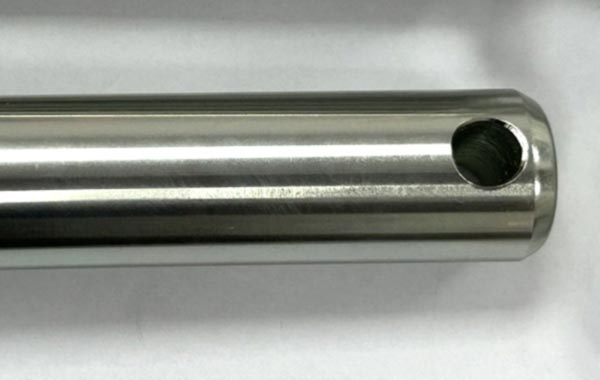
1. Here is a systematic solution set, with the core principles being “chip control”and “chip breaking”. The root cause of scratches is chips that fail to evacuate properly, instead wrapping around the workpiece or tool and rubbing against the finished surface.
• Chip Control – The Core is “Guiding” and “Breaking” • Select the Correct Chipbreaker Geometry:This is the most critical step. Choose an insert with the appropriate chipbreaker type (e.g., V-type, wavy) and width for the material (steel, stainless steel, aluminum, etc.) and depth of cut. A good chipbreaker will curl and break chips into small “C” or “6” shaped segments.
• Adjust Cutting Parameters to Aid Chip Breaking:
• Feed Rate:Moderately increasing the feed rate (f) helps create thicker chips that are more prone to breaking. Balance this with surface finish requirements.
• Cutting Speed:Excessive speed can soften chips, making them gummy; insufficient speed can lead to long, stringy chips. Find the optimal speed range.
• Use a Chipbreaker / Baffle:For specific operations, a mechanical chipbreaker can be mounted on the tool holder to forcibly change the chip’s direction and break it.
2. Optimize Cutting Parameters and Tool Path
• Final Finishing Pass:Use a small depth of cut (ap), appropriate feed (f), and higher cutting speed (Vc) for finishing. This improves surface quality and generates chips that are easier to evacuate.
• Alter the Tool Path:If possible, try machining from the OD towards the center (reverse turning). This allows chips to fall directly onto the carriage or chip pan without dragging across the finished surface. Consider machine and fixture rigidity. • The “Spring Cut” Technique:After the final finishing pass to size, take an additional pass along the Z-axis without changing the X-axis position (zero depth of cut). This effectively removes burrs and potential scratches.
3. Tool Selection and Maintenance
• Sharp Cutting Edge:Always use sharp inserts. A dull tool rubs and deforms material instead of cutting it, generating excessive heat and uncontrollable, stringy chips that easily scratch surfaces.
• Suitable Nose Radius (Corner Radius):A smaller nose radius cuts more sharply and produces narrower chips but has lower edge strength. A larger radius improves surface finish but may hinder chip evacuation. Choose based on finishing requirements.
• Positive Rake Angle Inserts:Typically produce smoother cutting action and more controllable chips.
• Correct Tool Center Height:Ensure the tool tip is exactly at the workpiece centerline. Incorrect height alters the effective rake and clearance angles, affecting chip flow and cutting performance.
4. Adequate Cooling and Lubrication
• Role of Coolant:Beyond cooling. High-pressure, high-volume coolant effectively flushes chips away, preventing them from lingering in the cutting zone. Crucial for gummy materials like stainless steel and aluminum.
• Application Point:Direct the coolant stream at the point where the chip forms at the cutting edge to directly assist in chip breaking and evacuation.
• Use High-Pressure Coolant (HPC) Systems:High-pressure coolant acts like a “water jet” to effectively break and wash away chips, making it a powerful solution for difficult-to-machine materials.
• Lubricity:For materials like aluminum, use cutting fluids with better lubricity or specific fluids like kerosene to reduce chip adhesion.
5. Operational and Auxiliary Techniques
• Programmed Pauses / Using a Hook:For long shaft machining, program pauses to allow the operator to safely remove wound chips with a hook. (Safety First! Only when the machine is fully stopped.)
• Workpiece and Fixture Cleanliness:Thoroughly clean the chuck and fixtures of chips before mounting a new workpiece to prevent imprinting chips onto the surface.
• Use Compressed Air for Blowing:Before finishing passes or after tool changes, carefully blow away residual chips from the workpiece and machine using an air gun. (Equip with an air dryer/filter to prevent water/oil contamination.)
• Nylon Brush / Soft Brush:Gently brush away fine chips from the workpiece surface with a nylon brush while it rotates at low speed, suitable after finishing.