
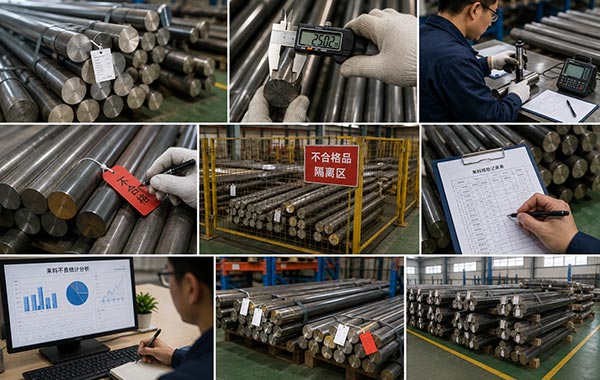
Incoming material quality is an important starting point for effective product quality control. Raw materials, purchased components, and subcontracted parts with incorrect material properties, dimensional deviations, deformation, corrosion, cracks, unacceptable hardness, or other nonconforming characteristics can lead to machining scrap, batch rework, process instability, and finished product quality issues. If incoming inspection fails to identify these problems before the materials enter production, additional material, tooling, and labor costs may be incurred, along with an increased risk of delivery delays.
A systematic approach to incoming inspection, segregation of nonconforming materials, and supplier quality management should therefore be established:
- Strengthen Incoming Inspection: Upon receipt, Incoming Quality Control (IQC) personnel should verify the material or part number, specifications, batch information, and relevant material certificates according to inspection requirements. Visual inspections should also be performed as required, with particular attention to corrosion, deformation, cracks, impact damage, and machining defects. This helps prevent incorrect or nonconforming materials from entering production.
- Strengthen Verification of New Batches and Critical Materials: Materials from new suppliers, new incoming batches, and critical components should undergo enhanced dimensional and quality verification in accordance with drawings, technical specifications, and inspection requirements. When necessary, a full dimensional inspection should be performed before the materials are released for production to confirm that dimensional tolerances, geometric tolerances, and surface condition meet the specified requirements.
- Promptly Identify and Segregate Nonconforming Materials: When nonconforming incoming materials are identified, they should be clearly marked and immediately moved to a designated quarantine area to prevent accidental mixing or use. Details such as the type of defect, affected quantity or defect rate, and batch number should be recorded. The issue should then be communicated to the supplier for root cause analysis and corrective action.
- Establish Incoming Quality Records and Traceability: Incoming quality issues should be continuously recorded and analyzed by supplier, including defect types, frequency, and recurring problems. Suppliers with repeated dimensional deviations, surface defects, or unstable material or performance characteristics should be subject to enhanced quality control and corrective action requirements. Continuous monitoring and improvement help strengthen overall supply chain quality.
- Strictly Control the Use of Materials with Major Quality Issues: Materials with significant batch defects, incorrect material properties, or nonconforming critical performance characteristics should be immediately segregated and withheld from production. They should not be released for use until the quality issue has been properly reviewed and dispositioned. This helps prevent unnecessary tool wear, labor loss, and batch scrap caused by continued processing of nonconforming materials.
Early detection, timely segregation, effective supplier feedback, and continuous improvement can significantly reduce the risk of nonconforming incoming materials entering production and provide a reliable foundation for machining quality and process stability.