
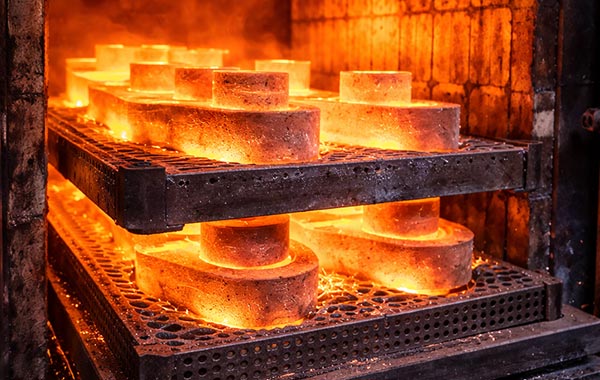
During forging production, forging primarily defines the shape of the part, while heat treatment determines the final microstructure and mechanical properties of the forging. Whether the heat treatment is properly controlled has a direct impact on product stability and service reliability.
1. Role of Heat Treatment in Controlling Forged Microstructure
A. Typical Issues in As-Forged Microstructure
After forging, I have found during metallographic inspection that forgings often exhibit non-uniform grain size, local overheating, or insufficient deformation in certain areas. If these issues are not addressed, they will directly affect subsequent mechanical performance.
B. Practical Effects of Normalizing and Annealing
In actual production, through properly applied normalizing or annealing treatments, I am able to refine grains, homogenize the microstructure, and establish a stable structural foundation for subsequent quenching and tempering or direct service use.
2. Decisive Impact of Heat Treatment on Mechanical Properties
A. Balance Between Strength and Toughness
By comparing different heat treatment schedules, I have observed that quenching temperature and cooling method directly influence the balance between strength and toughness. Improper parameters often result in excessive hardness or insufficient toughness
B. Control of Property Variability
In mass production, by standardizing soaking time and cooling conditions, I have effectively reduced property variation between furnace batches, thereby improving overall product consistency.
3. Residual Stress Relief and Dimensional Stability
A. Sources of Residual Stress in Forgings
During forging, residual stresses are inevitably introduced due to large plastic deformation and non-uniform cooling.
B. Necessity of Stress-Relief Heat Treatment
During subsequent machining and assembly, I have found that forgings without stress-relief treatment are more prone to distortion or even microcracking. Proper stress-relief heat treatment significantly improves dimensional stability.
4. Coordination Between Heat Treatment and Subsequent Processes
A. Compatibility with Machining
In production, I have observed that when the heat treatment condition does not match the machining process, tool wear increases and machining-induced deformation becomes more likely.
B. Alignment with Service Performance Requirements
For different service conditions, I define heat treatment objectives at the process planning stage to ensure that the forging achieves the required strength, toughness, and reliability in actual use.
Through long-term production practice, I have confirmed that heat treatment is not a secondary operation following forging, but a critical process that runs throughout quality control. Only by systematically coordinating heat treatment with the forging process can high-performance and highly consistent forged products be reliably achieved.